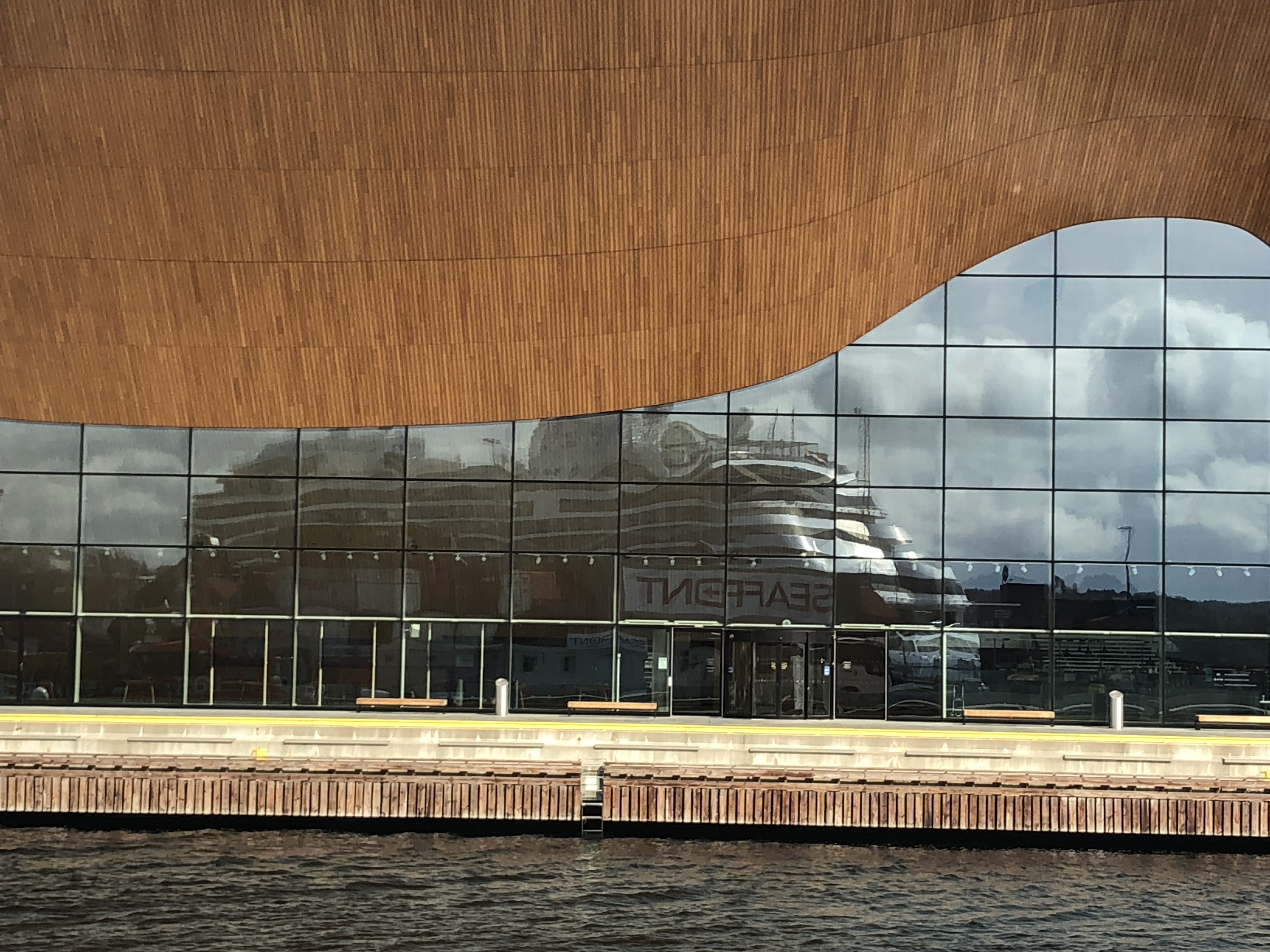
Regent Seven Seas’ Explorer is reflected in the windows of the concert hall in Kristiansand, Norway.
I’ll admit it. I hate cruises. You’re
stuck with thousands of people, people get on your nerves, staff make too many
mistakes, and the tours aren’t usually that great.
But then I recently took a cruise on
Regent Seven Seas’ Explorer. Unlike P&O, MSC, and other cruise ships for
the masses, Regent Seven Seas is considered to be a luxury liner the likes of
which makes even Cunard pale in comparison.
Yes, the prices will make your eyes
water (a 7-night cruise usually starts at £10,000 per person), but there are
many discounts on offer to help the costs a little. One thing that stands out
when you look at a Seven Seas Cruise is that the costs are front-loaded. By
that, I mean that you really don’t need to spend anything unless you want a spa
day, to buy something from the gift shops on board, or try a premium drink.
The price includes your stateroom,
all meals in all restaurants, most alcoholic beverages, soft drinks, specialty
coffees, ice creams, and most importantly, excursions. All of these are usually
extra costs on the other cruise liners where prices seem a lot cheaper.
The cruise my family did was a
12-night Norwegian cruise along the western coast above the Arctic Circle and
into the fjord lands of this beautiful country. This included ports such as
Copenhagen, Denmark; Kristiansand, Bergen, Hadstad, Geiranger, Bodø, Aselund,
Norway; Gothenburg, Sweden, and Oslo, Norway. Of the 12 days on board, two were
at-sea days and one included a technical stop before anchoring at Geiranger for
a day.
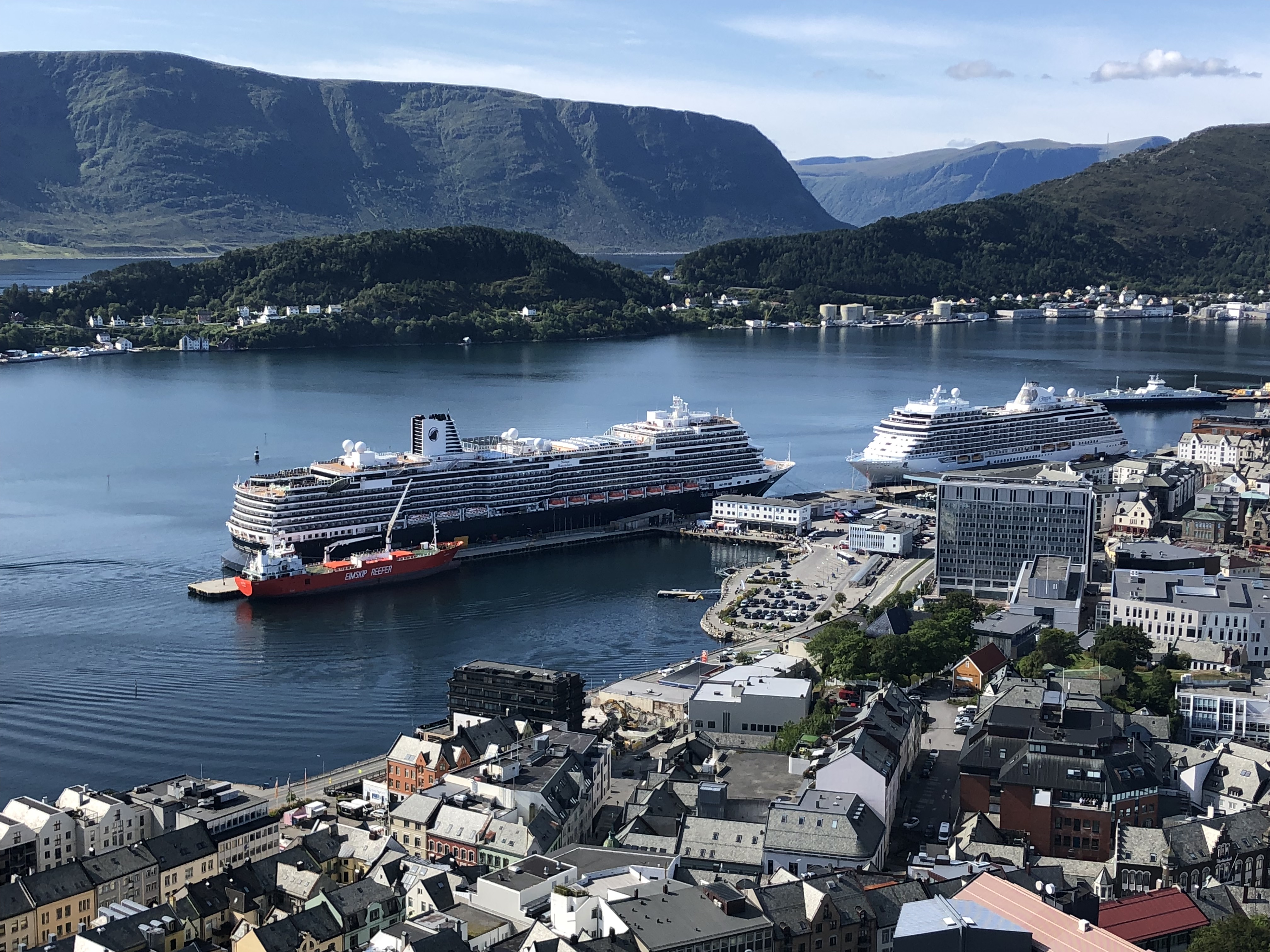
The Regent Seven Seas Explorer can be seen from a lookout point in the Norwegian town of Aselund.
One of the striking differences between Regent and other companies is that the ships are relatively smaller. Explorer, the largest ship in Regent’s fleet, can accommodate 750 passengers, a far cry from the 5,000-plus the super carriers can house. It also has capacity for a staff of more than 700 which means you have an almost 1:1 ratio of passenger to staff. Other companies are lucky if the ratio is 10:1 passenger to staff. This makes a significant difference when it comes to your experience on board.
Explorer staff are very attentive
and will remember you. I had the habit of having afternoon mojitos and malbec
at dinner. After two days I didn’t need to order, the staff remembered what I
drank.
Meals are provided in several
restaurants. Veranda is the buffet style restaurant on the top of the ship. In
the evening, a part of Veranda becomes Sette Marie, an Italian restaurant.
Compass Rose is the formal dining room. The ship also has the pool grill
restaurant which is open at lunch and dinner. There are three specialty
restaurants on board: Prime 7 (steakhouse), Chartreuse (French), and Pacific
Rim (Asian). You are encouraged to make reservations at each of the three
speciality restaurants.
Seven Seas’ other draw is that the
majority of the land excursions are included in your price. The only time you
pay a supplement is if your excursion is something like a boat ride, a hike, or
a visit to a family’s home. If you are interested in the panoramic or museum
tours, these tend to be at no extra cost. Nothing adds up on your tab on other
ships like excursions. You can easily spend thousands extra on tours especially
on a 14-plus day cruise.
Overall, I found Regent Seven Seas
to be well worth the price of admission. It follows the old adage: You get what
you pay for. Yes, you will probably never pay more for a holiday than you will
on Regent Seven Seas, but your experience most likely will be something you’ve
never had before. Regent has four ships in its fleet with Explorer the newest
having launched in 2016. Next year, Regent will launch its fourth ship,
Splendor.
Not all business class seats are
created equally. A part of the reason people pay a premium to fly business
class is the privacy on board.
We’ve seen it before in economy
class where you have to fight for the armrest, wake people up to get out of the
window seat to use the toilets or having the seat in front of you reclined so
the seat back is in your face.
There is zero privacy in economy,
but there are a variety of business class seats that that offer you an oasis in
the air. This post will look the best five business class seats on offer.
One of the criticisms of business
class travel in BA, Lufthansa, and some products on Air France and KLM is the
privacy issue. BA is configured in such a way that, unless you are seated at
the front or back of the cabin, you will have step over someone’s feet to get
into the aisle. Lufthansa and some Air France and KLM configurations are two
seats at the window, two in the middle, and two at the other window. Again, if you
are seated at the window, you have to climb over people to get out.
The most ideal cabins are the ones
that offer aisle access to all passengers. Usually, this is achieved with a
1-2-1 configuration, but not always.
I will examine cabin layout, advise
on which seats are most ideal, and give you the pitch and width dimensions. Pitch
refers to the distance from the back of the seat in front of your seat to the
front of your seat. Width refers to the wideness of your seat from armrest to
armrest.
5. Emirates staggered system
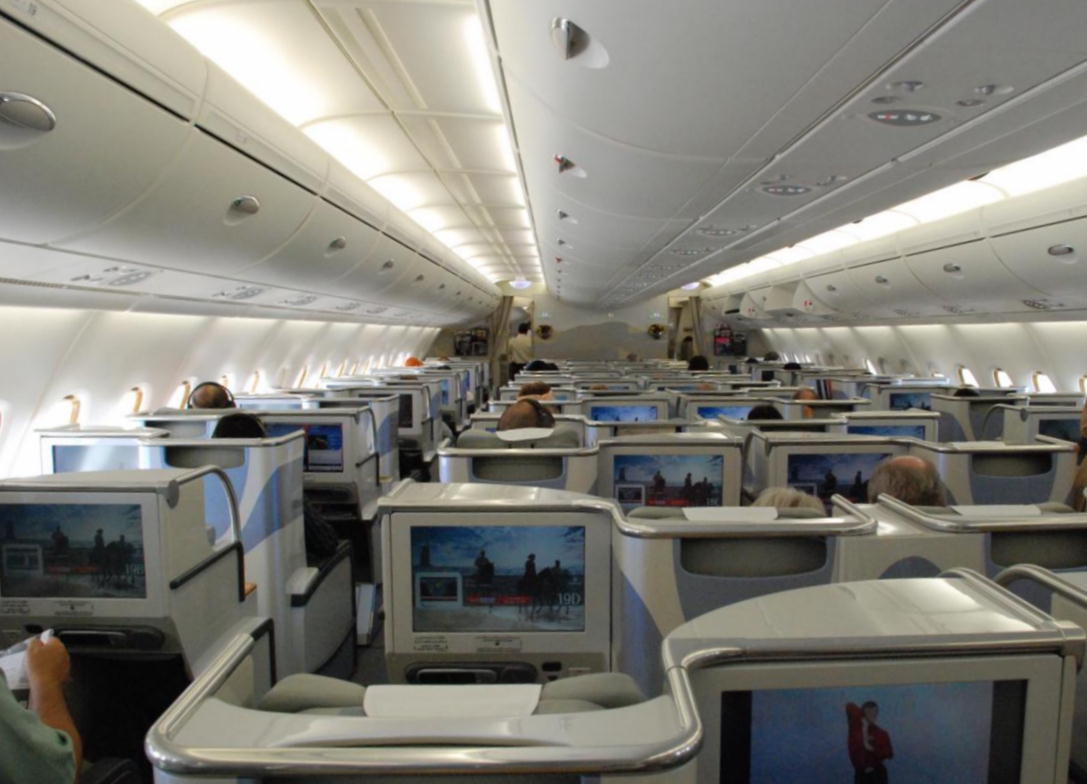
Emirates Airlines A380 business class product offers seats that alternate between direct aisle or seats that are closer to the window.
The Emirates Airlines business class seat alternates between seats
at the window and seats closer to the aisle for the window area seats. For the
middle seats, it alternates between two seats next to each other or spaced
closer to the aisle.
Each seat has a small table with a
minibar of soft drinks. The best seats for solo travellers that will give you
the most privacy are those where the seat is closer to the window. This does
two things: The table is next to the aisle which adds more privacy to the seat,
and; between your seat and the window are a set of storage containers that give
you additional space for smaller items.
If you travelling as a couple or
with a friend, the middle seats right next to each other are best because you
are shielded with the tables from the aisle and you are next to each other.
On the superjumbo Airbus A380, the
business class cabin in most configurations takes up most of the upper deck of
the aircraft. Business class is divided into two cabins. One of the best seats
is the bulkhead (first row of the cabin) in the back, smaller cabin of the
aircraft. Not only is your seat next to the window with the table adding extra
privacy, but the bulkhead wall also adds to the privacy. The one drawback is
that you are close to the bar at the back of the plane which can get a bit loud
on routes where people like to congregate at the bar.
Other airlines that use a similar configuration: Thai Airways; All Nippon Airlines
Pitch/width: 48
inches/18.5 inches. A disadvantage of Emirates is that it offers one of the narrowest
business class seats. It is only ½ inch wider than economy.
4. Herringbone
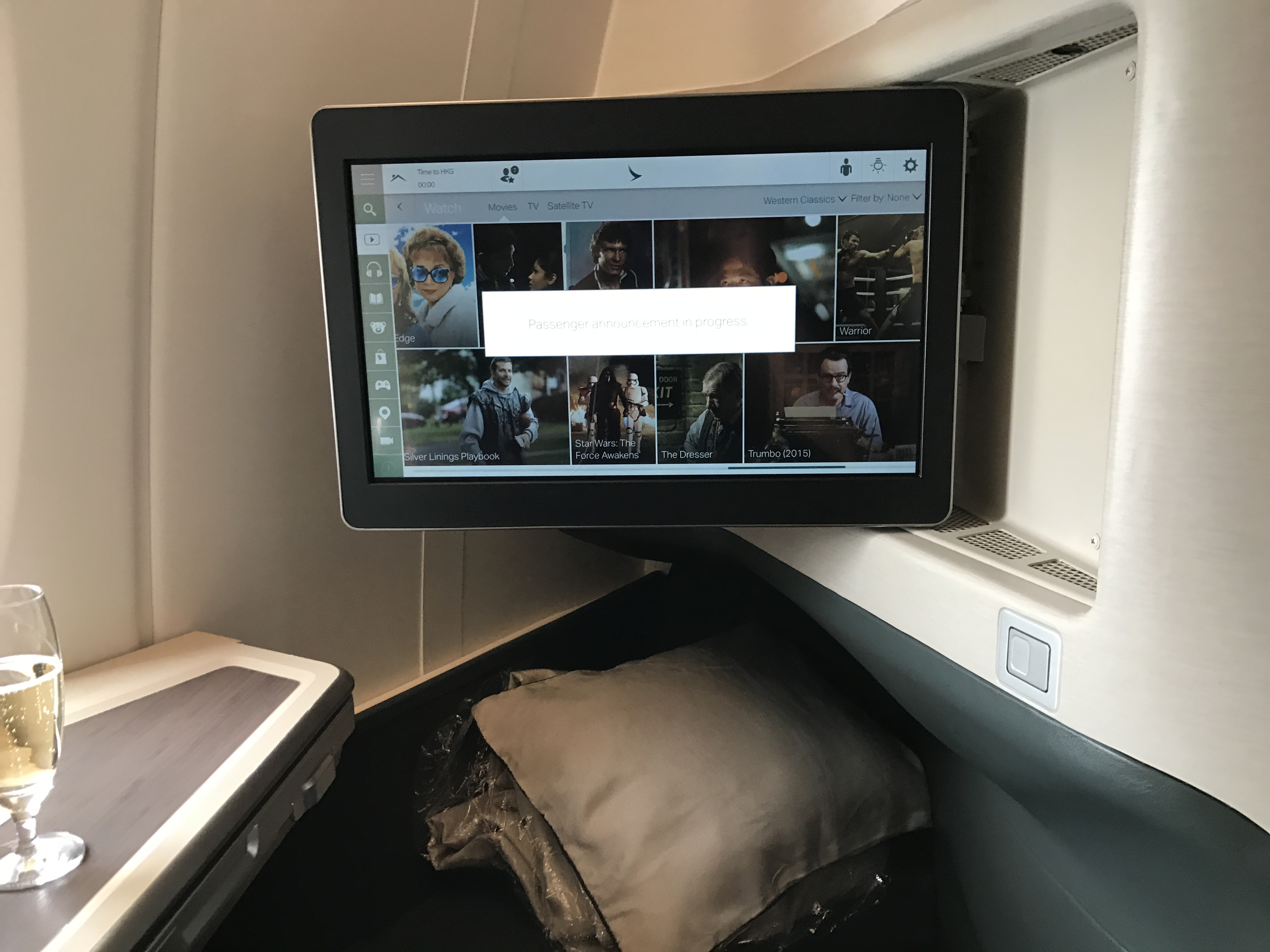
In Cathay Pacific’s Airbus A350-900, the reverse herringbone sits at a 30-degree angle to the plane. The TV slides out from a side panel for viewing.
This is pretty much what it sounds like it is. An overview looks like fish bones. The cabin is laid out in a 1-2- format which means aisle access for all.
Passengers sit at an angle to the
direction of the plane which means you sit at about a 30-degree angle to the
path of flight. But this isn’t something that makes a difference as you don’t
really feel it.
There are two types of herringbone
seating: forward and reverse.
Virgin Atlantic offers the forward
variety which isn’t as great as you can’t look out your window, you face the
aisles, and you lose a bit of that privacy.
The reverse herringbone is much better
because you face inward and the seat shell tends to give you a bit more
privacy.
Reverse herringbone configurations: Cathay Pacific, Finnair, newer KLM/Air France business class, and
Air Canada
Pitch/width: Air Canada
(70/21); Cathay Pacific (81/21); Finnair: (78-81/21). As you can see, reverse
herringbone gives you a lot more leg room and seat width than the Emirates
seat. Because you are sitting at an angle, the legroom is greater because you
are seated diagonally from the front.
Recommended seat: Either
the last row of the main business class cabin or in the smaller business class
section if offered. This gives you a bit more privacy. If you are in the last
row of business class, then no one other than the odd flight attendant will
walk past you.
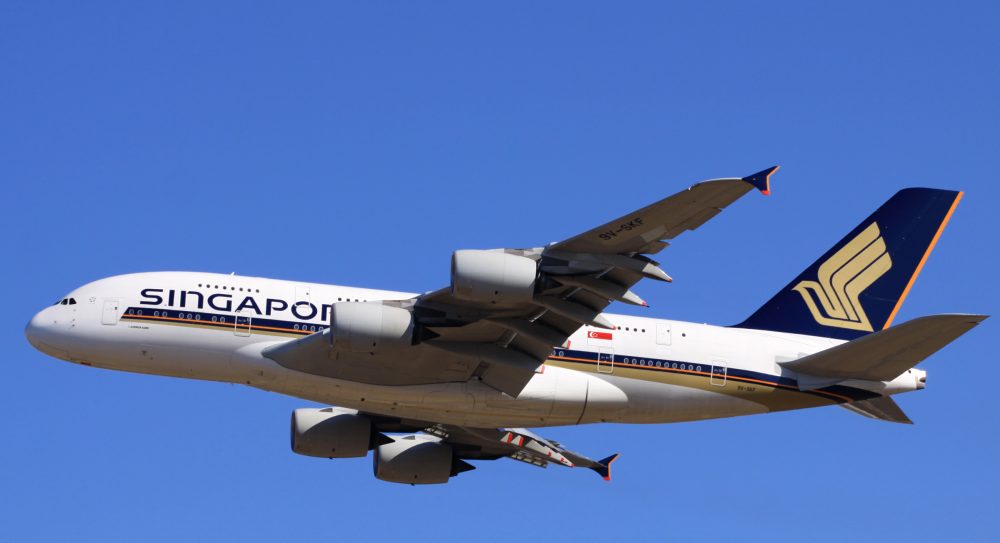
3. Singapore Airlines new business
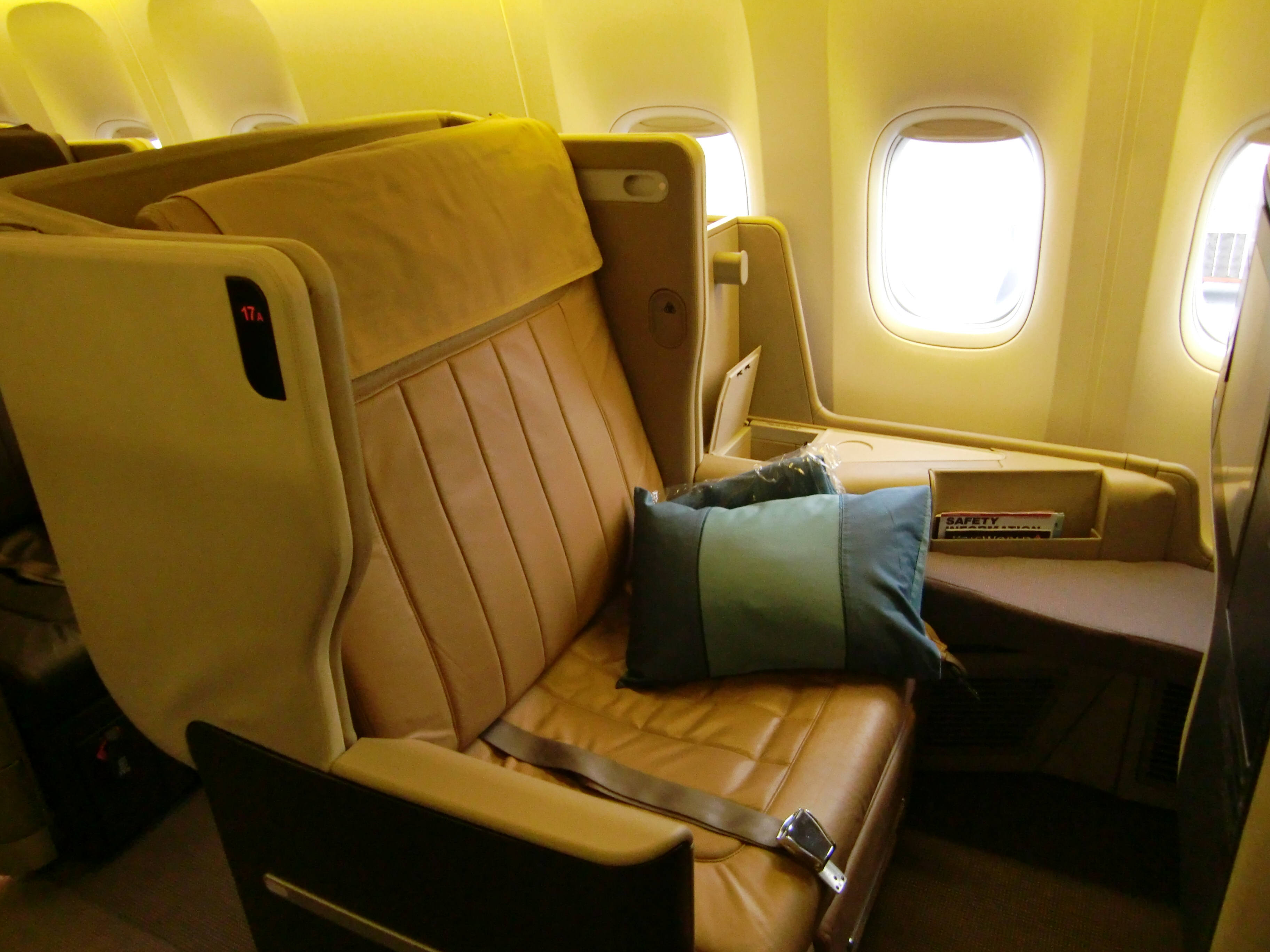
Singapore Airlines offers the largest business class seat in the industry.
Singapore Airline often ranks as the world’s best airlines. Skytrax, the industry standard for airline ratings, often rates Singapore in the top 3 for overall experience, usually in the No. 1 spot.
This high rating also comes from the
business class seat. It is in a 1-2-1 format and has the widest seat in any
business class. It is so wide that you can fit two children in one seat.
Among the amenities you get are the
two pillows and a thick duvet for the flight. Unlike other business class
products where you push a button and the seat collapses down into the bed
position, Singapore’s bed is created by undoing a latch on the seat back and
pulling down the seat back to form the bed. That is why it also has the highest
seat back of any airline.
The one criticism of the Singapore
seat is that, even though it faces forward, when it is in bed mode, your feet
are forced to be at an angle to your body because the foot well is off to the
side of the bed. This tends to be what people don’t like about the product.
Pitch/Width: 55/30. To put
into perspective how good any cabin in Singapore Airlines is, their seat width
in economy class (19) is wider than Emirates’ business class (18.5).
Best seat: If you are on
the superjumbo A380 in which business class takes up most of the upper deck,
the very last row (row 96 old configuration; row 97 new configuration) are
best. Yes, the toilets are not far and the galley is behind you, but these are
emergency row seats which means it’s like a suite to yourself. But, since
Singapore tends to be too pricey for most people, there are times when the back
end of the A380 could be just a handful of passengers. Singapore tends to use
these planes on its Singapore to Australia and Singapore to Western Europe
routes.
Who else offers these seats: No one. It is bespoke to Singapore Airlines.
2 Apex Suites
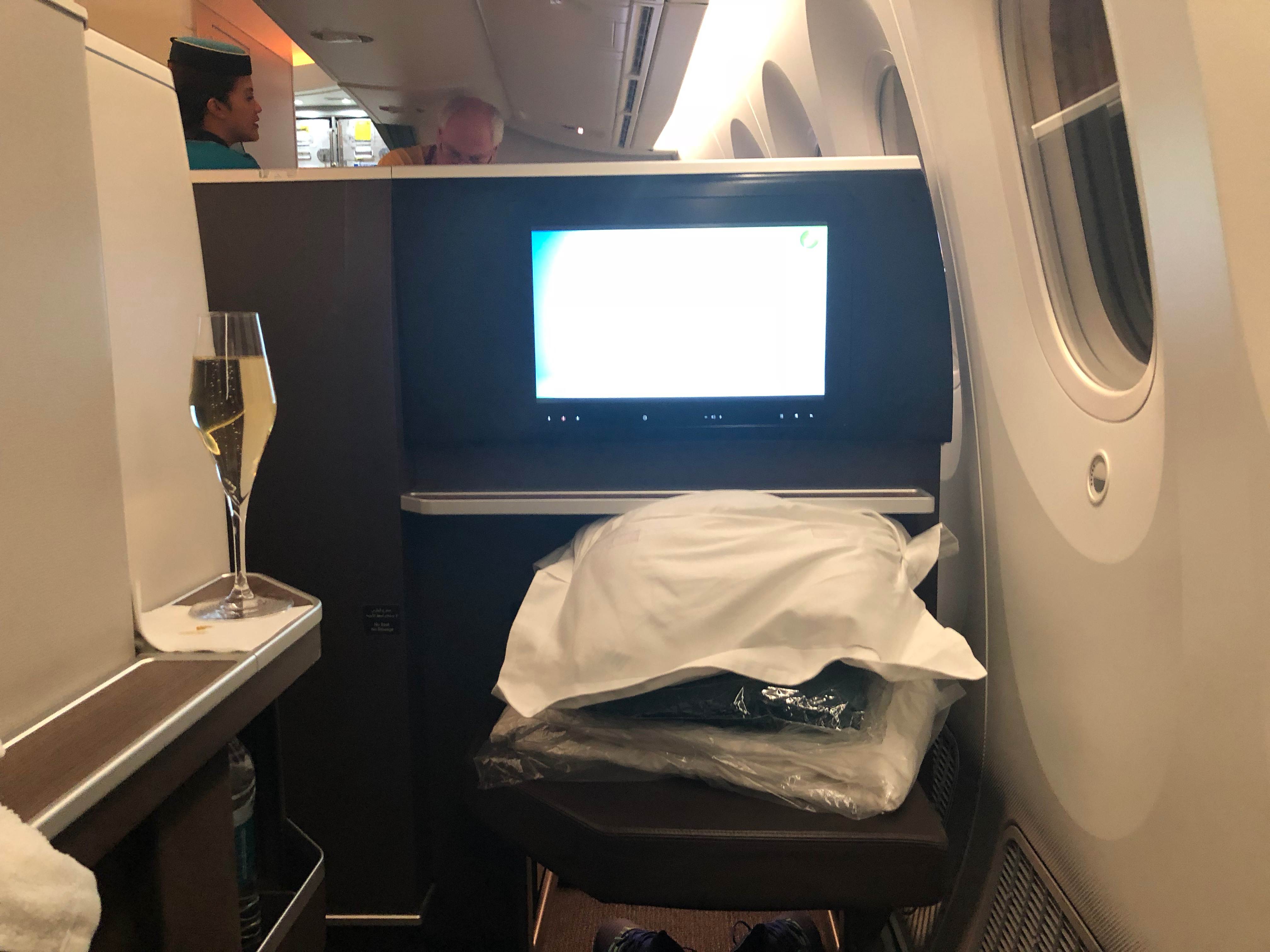
From a seated position, it is evident how much privacy you have in the Apex Suite on board the Oman Air Boeing 787-9.
On first glance at a seat map of an Apex Suite looks like a 2-2-2 configuration. But it isn’t. The window seats are set slightly ahead of the aisle seats which creates a little passageway behind the aisle seat TV so you don’t have to climb over anyone.
This means the window seat is almost
closed in save for the passageway. You get even more privacy if you bring up
the privacy screen that separates your seat from the one next to you.
In terms of privacy, these are among
the very best seats.
For people travelling in pairs, the mid-cabin
seats are next to each other but you still have a bit of privacy as you have to
walk through the galley to the other side to get to the other seat.
Airlines that offer Apex Suites: JAL, Oman Air
Pitch/Width: JAL
(74/25.5); Oman Air: 80/22.8)
Best seat: Any of the
window seat. If you are travelling on Oman Air’s Boeing 787-9, Row 15 is in a
cabin all to itself so you won’t have more than six passengers in the cabin.
When I used this service, there were six of us travelling together so we had an
entire cabin to ourselves including a toilet just in front of the cabin.
1 Q-Suites Qatar Airways
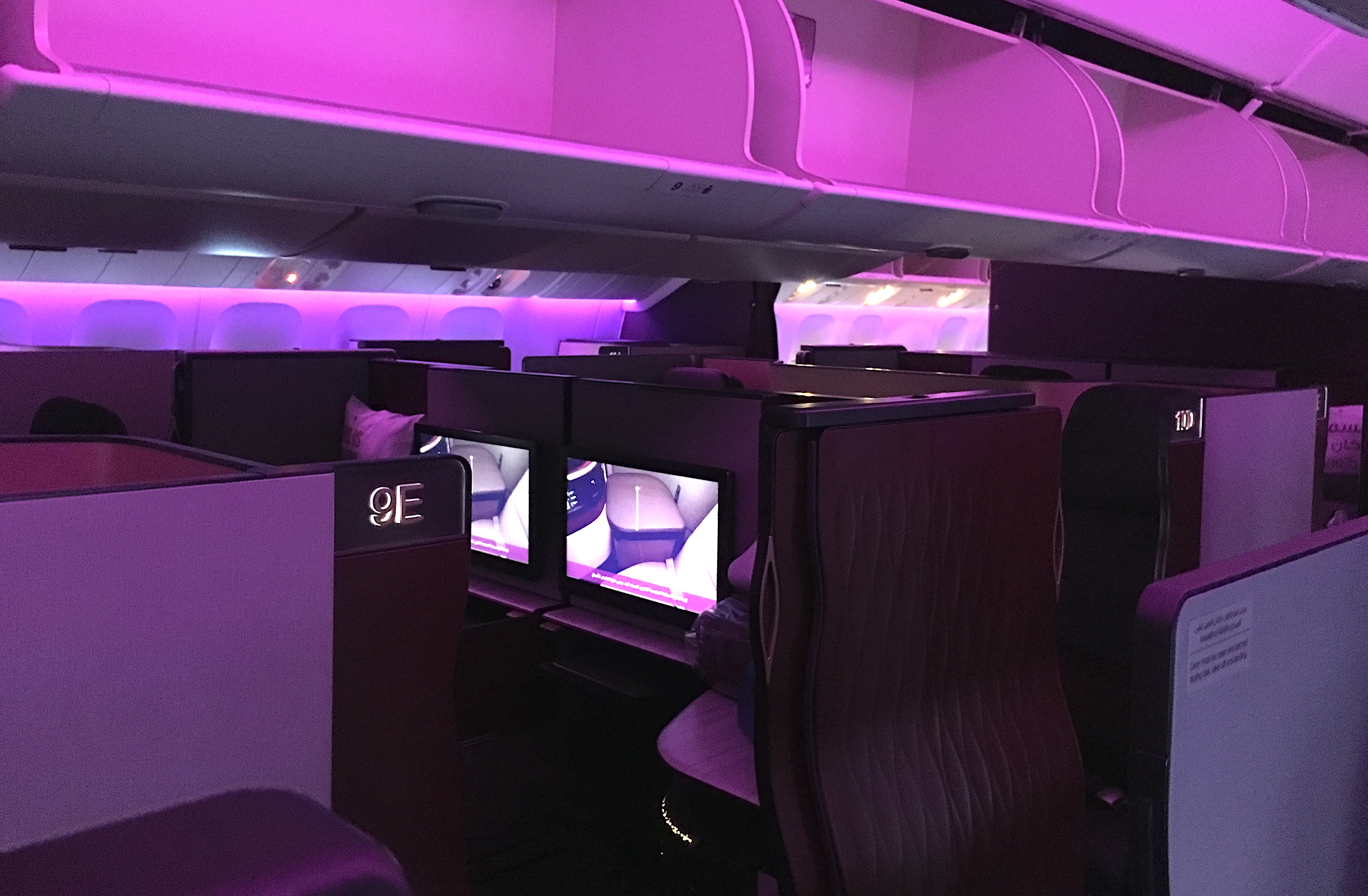
Qatar Airways offers you chance to experience first-class travel in business class in its new Q-Suite product which features sliding doors that create a completely private suite normally located in first class.
Qatar Airways offers three types of configurations in business class: a regional 2-2-2 with no aisle access for window seats (Boeing 777s; Airbus A330, A340); reverse herringbone (Boeing 787, Airbus A350-900, A380), and; Q-Suite (Newer Boeing 777s; Airbus 350-1000).
Q-Suites were launched in 2017 with
a clever marketing slogan: “First in Business”. It was a first because no other
airline offered it and it is like first class in business class.
The configuration is 1-2-1 but all
seats have a sliding door to create a completely private suite similar to some
of the high end first class cabins in Singapore Airlines, Emirates, or Etihad.
Like Emirates, seats alternate
between being next to the aisle or a table away from the aisle.
The window seats next to the aisles
face backward while the aisle seats are forward-facing. Once you’re in the air,
you can’t tell the difference if you are facing the tail or the nose of the
plane. It is most telling on taxiing, take-off, and landing.
It is also the same configuration
and direction for the middle seats. The seats next to each other face backward
while the ones on the aisles face forward.
But what makes the Q-Suites even
more amazing is the fact that if you are a family of four or a group of four,
you can take up two rows of the middle seats, and the panels can be removed
inside to create a small apartment for four. Also, when converting to a bed,
the two inside sides that are adjacent to each other can be turned into a
double bed when the crew puts a long padding between the seats.
Q-Suites is Qatar Airways’ way of
providing a first class experience at a business class price. In fact, Qatar
Airways is moving away from First Class. As it stands, only five of their aircraft
types have a first class cabin.
Airlines that off Q-Suites: Only Qatar, but the concept of having a sliding door in a business
class seat is catching on as BA will soon roll out their Airbus A350 service
with a sliding door.
Pitch/Width: Boeing
777-300ER (79/21.5); Boeing 777-200LR (103/17.4); Airbus A350-900 (103/21.5);
Airbus A350-100 (103/21.5).
Q Suite routes: Here is a
list of Q-Suite flights Qatar Airways offers. Flight numbers are in brackets).
Asia-Pacific:
Bangkok (830/831);
Bangalore (572/573); Hong Kong (816/815, 818/817); Maldives (672/673, 674/675);
Mumbai (556/557); Shanghai (870/871); Sydney (906/907); Singapore (942/943,
944/947, 946/945); Beijing (892/895, 896/895); Tokyo Narita (806/807); Tokyo
Haneda (812/813); Canberra (906/907); Auckland (920/921).
Europe:
Amsterdam
(273/274); Berlin (77/78, 81/82); Frankfurt (69/70); London (1/2; 5/6; 7/8;
15/16); Paris (37/38); Stockholm (171/172); Zurich (93/94, 95/96); Munich
(57/58, 59/60); Milan (123/124, 127/128); Copenhagen (161/162)
Americas: Chicago
(725/726); Houston (713/714); New York JFK (701/702; 703/704); Washington DC
(707/708); Los Angeles (739/740); Dallas/Fort Worth (729/730); Boston
(743/744); Montreal (763/764); Sao Paulo (773/774); Buenos Aires (773/774)
Cathay Pacific’s reverse herringbone design in its business class offers you excellent privacy as you fly their ultra long-haul routes.
Air traffic is no longer the
glamourous experience it once was. Post-9/11 travel means invasive searches,
long lines at security, and removing various articles of clothing.
After that, you wander aimless for a
couple of hours around an airport terminal looking at “duty free” items that
seem to be more expensive than the high street or you buy a bottle of soft
drink for the price of a six-pack.
You then bundle onto a plane and are
crammed in like sardines with people who recline the seat to within inches of
your face or next to someone who has never heard of deodorant or a shower.
So if it is like this, is it worth
investing in business class?
That means dedicated, shorter check
in lines, exclusive lanes and areas in the security area, and a lounge far from
the maddening crowd often with “complimentary” food and drink. I saw
complimentary in quotes because it isn’t free. You paid for it when you paid at
least five times the economy rate for your ticket.
Yes, the drawback of business class
is it is very expensive, often in the several thousands of pounds. But there
are ways around that.
Points systems
Loyalty has its perks. Belonging to
an airline alliance means accumulating points that can be used towards a free
flight or a deeply discounted one.
There are three main alliances: Star Alliance, One World, and Skyteam.
Oddly, two of the worlds biggest
airlines — Emirates and Etihad — do not belong to any alliance, but you can
accrue points for Qantas because the Australian carrier has a codeshare
agreement with Emirates.
Every time you fly, you collect
points proportionate to the distance travelled. However, accrual is based on
the level of your ticket. The cheapest prices usually mean fewer perks
including sometimes lower accrual. For example, some airlines will only allow
you to accumulate 50 to 75 percent of the actual number of points on a
non-flexible sale fare. The more you pay for a ticket, the more points you get.
A business class ticket accrues at a rate of 150 percent for the lowest ticket
and sometimes 200 percent for the full fare.
When you collect points, you accrue
two types of points: usable points and tier points. When you’re waiting to
board a flight, you may hear the ticketing agent talk about “Oneworld Emerald”,
“Star Alliance Gold”, “Skyteam Elite Plus”. These are the highest tiers in the
alliances. The more points you accrue the more tier points you get. When you
reach certain levels, you move up to the next tier level. Being at the highest
tier level gives you perks such as free access to lounges and free upgrades. So
if someone tells you they got a free upgrade to business, the most likely
reason is because they belong to a high tier in an airline alliance programme.
But since most of us don’t fly more
than a few times a year, it is difficult to accumulate points. This is why the
major alliances partner with credit card companies to offer you the chance to
accumulate points faster. Let’s take a look at the American Express British
Airways Express Platinum Plus card as an example of points accrual.
New card members will earn 25,000 BA
points if they spent £3,000 in the first three months of membership. For every
£1 spent on the card above and beyond that, you accrue 1.5 point. When you
purchase travel with British Airways, you also get 3 points for every £1 you
spend.
Remember, points are use to offset
the cost of the flight and not the taxes. You still have to pay the taxes. So,
let us say you spent £3,000 in the first three months of card usage. Your
25,000 makes you eligible for a free economy flight in the peak season from
London to Vancouver. You just have to pay £239.12 for the taxes. So basically,
you can fly roundtrip from London to Vancouver for £239.12. No charter airline
offers that.
Looking again at the most expensive
time of travel, you would need 75,000 for a business class flight to Vancouver
from London and pay just £418.62 for the taxes. But you can get a business
class flight on this route for as low as 37,500 points plus £1,113.62.
Yes, £1,113.62 is a lot of money but
when you consider that you are accumulating points as you go about your daily
life, it isn’t that bad because a business class flight from London to
Vancouver at the height of peak season will cost £3623.52.
Ask because you never know
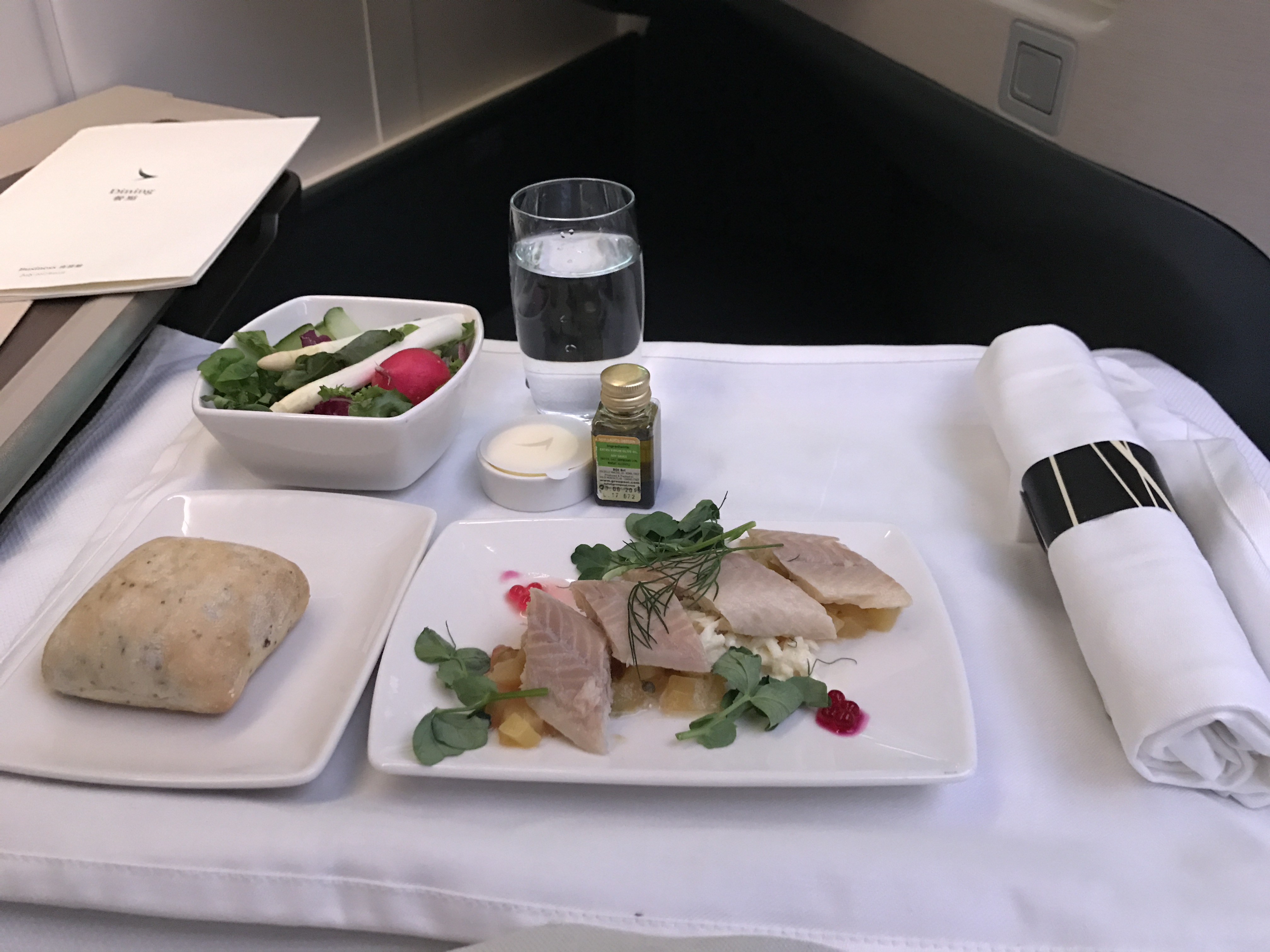
Table service is one of the perks of flying business class.
It also doesn’t hurt to ask at check
in if there are any upgrades available. Sometimes you might happen upon a bargain.
When I was moving from Canada to the
UK, I called KLM a few days before my flight to see if they anticipated any deals
on upgrades. The reason I did this was because I knew KLM is a very popular
airline on the Toronto to Amsterdam route because it offers a lot of connecting
flights into Africa and is popular with Africans returning home for holidays.
I was told there could be a deal and
to check at the airport. Even before check in opened, I went to the ticket
counter and asked and was told I could upgrade my Toronto to Amsterdam flight
only for $250 (less than £150). But it doesn’t always work. I was once flying
from Toronto to London and was told the upgrade would cost $750.
The reason you can get a deal is
because airlines overbook economy. They sell more tickets than capacity because
they know there are no-shows or cancellations. If they know that they will be
overbooked they begin to offer deals and discounts to get people to move to
other flights or to move into business class.
Regional flights
This one tends to work well in
certain circumstances. Do not use this to fly a short haul flight in North
America or Europe unless the airline has a new plane it is putting through its
paces.
Regional business class tends to be
narrow jets with a tray covering the middle seats to give you the illusion you
have more room. The seat dimensions are the same as economy and you may get a
hot meal. That’s it.
However, if an airline takes
delivery of a new wide-bodied aircraft, then you can experience luxury for a
low price. For example, in the late 2000s, Air France took deliver of its first
superjumbo Airbus A380. Before it was deployed on international long-haul
routes, it was put through its paces and used to train staff on a Paris to
London route. Prices were the same as the normal smaller planes so you could
have experienced business class in a brand new airplane for £300.
But it is different in Asia where
many airliners use only wide-bodied jets. Cathay Pacific, Thai Airways, and
Singapore Airlines only flight planes with two aisles inside. So, if you fly
within the region, you will fly on an older plane but one with an authentic
business class product. Again, you would expect to pay about £300 for the
privilege.
Fifth freedom flights
Fifth freedom refers to an airline
being allowed to sell tickets for flights between two other countries.
Emirates, for example, has a flight
that goes Dubai-Bangkok-Hong Kong, Hong Kong-Bangkok-Dubai. Because Emirates is
based in Dubai it has fifth freedom to sell seats on the Bangkok-Hong Kong
sectors.
These are usually sold at regional
rates because these represent bonus income for the airline. So, for £300 you
can enjoy a 3.5-hour business class flight on an Emirates Airbus A380.
So, unless you have deep pockets and
lots of disposable income, business class flying is probably out of your reach,
but there are ways you can take advantage of offers that will allow you to
experience the joys of business class travelling.
Just remember one thing: Once you
try business class, it is very hard to go back to economy.
 Taking the road best travelled