
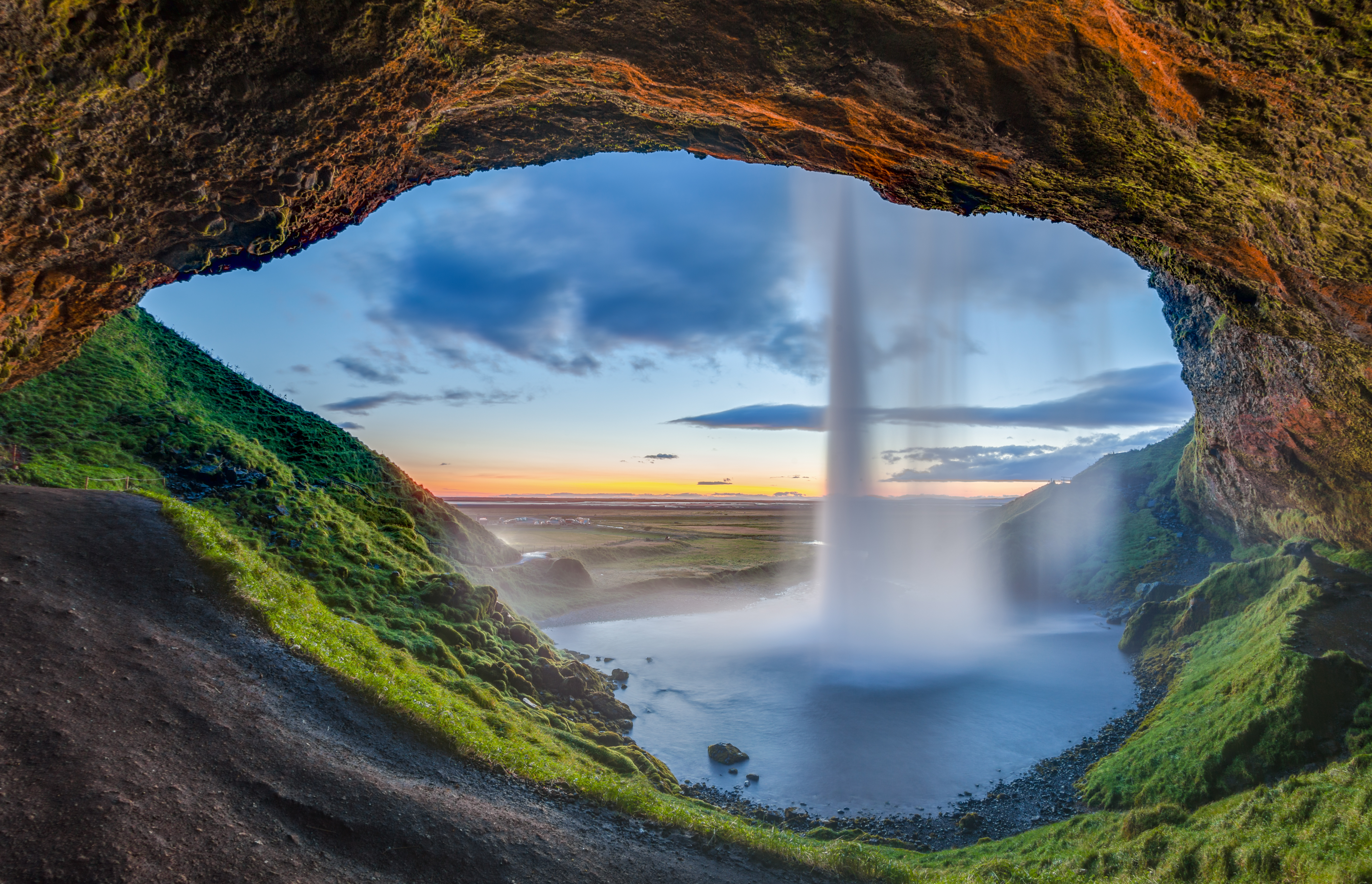
Back in the spring of 2010, a volcano on the tiny island nation of Iceland brought the world to a standstill.
Eyjafjallajökull (pronounced aye-ah-fyet-la-your-koot-sh) erupted, spewing ash into the air, which led to the closure of airspace and grounded all flights to and from North America and Europe for six days.
The volcano had a positive knock-on effect because suddenly Iceland was in the news and the collective conscious of people.
Tourism has spiked ever since with people wanting to visit this beautiful land of ice and fire.
Another positive result is that there are a large number of airlines that fly to the tiny Scandinavian country. Flights from Western Europe take about 2.5 to 3 hours while flights from the Eastern part of North America take about 4.5 to 5 hours and 8 hours from Western North America.
Getting there
The most direct flights are offered by Iceland’s flag carrier, Icelandair, while several other flag carriers offer direct and 1-stop flights to Iceland.
- Icelandair: Direct flights to and from major North American and European cities to Keflavik.
- Delta Airline: Operates direct flights from JFK in New York.
- EasyJet: Offers direct flights from several UK airports and Geneva.
- Eurowings: Seasonal flights from Cologne.
- Wizzair: Direct flights from Baltic nations.
- SAS: Direct flights to Oslo and connecting flights to Stokholm and other Scandinavian Cities.
- Norwegian: Direct flights to Oslo.
- British Airways: Direct flights to Heathrow.
- Air Canada: Seasonal to Toronto and Montreal.
- Finnair: Direct to Helsinki.
- Lufthansa: Direct to Frankfurt
All flights to Iceland arrive at Keflavik Airport which is about a 40-minute drive from the country’s largest city, Reykjavik.
One of the highlights of flying into Iceland, especially if you are coming from Europe, is the scenery you see when you first descend below the clouds. It is like nothing on earth. In fact, it looks like a different planet when you see the lava rock formations on the ground.
If you are on a night flight and the conditions are right, it could be possible to see the Aurora Borealis.
Getting around:
Iceland is a driver’s dream especially if you like driving over difficult terrains. If you are an inexperienced driver, then it may be better not to drive. Three people from the UK, including a baby, died in a crash last year due to a lack of experience of driving on rough terrain.
There is only 1 major highway, Route 1, which circles the country, and several rural paved and gravel roads that traverse the country.
It is possible to get around Iceland by airplane, but it is very expensive. Because the local airlines hold a monopoly, the price of flights between Reykjavik and Akureyri, Iceland’s second largest city, can be as much as the price of the flight you took to get to Iceland.
There is a reliable coach system which can get you around Iceland. But it can be even more expensive than flying around Iceland.
For the more physically fit, cycling around Iceland is an option. However, you should bring your own bike as purchasing a bike locally can be expensive.
Key destinations:
Pretty much of all Iceland is worth seeing and being such a small country, it is easily achievable to see the entire country in about two weeks.
For those of you on shorter trips, focus on certain areas. One of the most popular routes is the Golden Circle which will take you to Gulfoss waterfall, the Stokkur geyser, and other important areas of Þingvellir National Park. The park is also the site of the longest running parliament in the world and where the European and North American continental shelves meet.
Further afield and to the immediate north of Reyjkavik is Snæfellsnes which is not only a spectacular peninsula, but also the setting for Jules Verne’s Journey to the Centre of the Earth.
To the north of Snæfellsnes are the West Fjords, an area dominated by rugged geography and steep hills.
If you want to visit Eyjafjallajökull, it is located about 140 km southeast of Reykjavik near the town of Ásólfsskáli.
One of the most popular tourist destinations is The Blue Lagoon, which is about 40 km from Reykjavik. It is a surreal place because of its component and setting. It is a geothermal spa in the middle of a lava field. The result is a hot spring with milky blue water.
How to best see Iceland:
If you are experienced and comfortable driving on rough terrains, you can rent a 4×4 vehicle to see the country. Due to its small size, you are not far from your next destination so you won’t spend large amounts of time driving. You can set your bases in Reyjkavik to see the city and Snæfellsnes. Another base could be Ísafjörður to see the West Fjord Region. From Akyureri, you can strike out to see Myvatn. Höfn could be a good base from which you can visit the southeast of the country. Finally, Selfoss can be a good based to travel into the middle of Iceland.
The other major reason people go to Iceland is to see the Aurora Borealis. This is best seen in the winter months and there is even a forecast of the chances of seeing them on a day to day basis.
Cost:
Iceland is very expensive. If you have travelled to other parts of Scandinavia, then that will give you an idea of your costs. Accommodation outside of Reykjavik can cost about £75 and up per night. While you could expect to pay slightly more in the capital region.
Iceland is well known for its coffees which are excellent and the prices are comparative to Europe or North America. However, alcohol is very expensive. You could expect to pay about £35 for a bottle of house wine or £8.50 for a beer.
A tip for those who like to have a drink is to buy your alcohol duty free at Keflavik Airport. After baggage claim and just before you walk into the arrivals hall, there is a duty free shop which sells alcohol for about one-third less than the high street.
The first time I went to Iceland, I was chatting with a guy who was part of a stag party going to Reykjavik. It was pretty funny to see the colour drain from his face when I told him alcohol prices and he turned and berated the best man for choosing Iceland as a stag destination.
Weather:
Iceland is very far north and does not get warm. Also, the weather is very unpredictable. At the same time, the winters aren’t as cold as northern Europe or North America. The big thing about the weather in Iceland is the wind. It is such a wide open country that the wind can be jarring. Summer is cool. Don’t go there expecting the temperature to rise much more than 15C.
Last summer, I was there and where I was staying was 18C. But a quick drive about half an hour away in higher ground and the temperature was less than 10C. It changes very quickly and without notice.
It is not out of the question to pack warm clothing even in the summer. You do not want to be under-dressed in Iceland.
Safety:
Iceland also has a very tiny population. According to 2017 figures, a little more than 338,349 people live in Iceland with most of them living in the capital city.
In terms of safety, Iceland is extremely safe. Violent crime is very low and murder is even lower. In fact, there were no murders committed in 2008.
However, with the boost to tourism, there has been an increase in sexual assaults, rape, assaults, auto theft, and vandalism, but those figures are will well below other major cities.
 Taking the road best travelled