So now you have an itinerary in mind and have booked your flights. You are firmly committed to your trip at this point.
Up next is not hotel reservations, but rail pass purchasing. Intercity travel in Japan — by land, air or rail — is very expensive. You should invest in a Japan Rail Pass.
These passes are sold outside of Japan to foreign nationals and cannot be purchased in Japan. JR Passes are available in 7, 14, and 21-day packages and will cost you £211 (7-day pass), £336 (14-day pass), and £430 (21-day pass).
You should consult the go-to Japanese website for train prices and schedules, Hyperdia. This site allows you to plot travel based on date, time, and train type.
To give you an idea of how valuable the JR Rail Pass is, consider that a return train journey from Tokyo to Osaka will cost you £200 if you bought a ticket in Japan. That is almost the price of a 7-day rail pass.
Bear in mind, the JR Rail Pass cannot be used on the superfast Nozomi Shinkansen trains that operate from Tokyo to southern points. It is valid on the superfast north and westbound trains, the Hyabusa and Kagayaki respectively.
What happens after you order a pass?
A few days after your purchase, an exchange order will be in your post box. The exchange order is NOT a pass. You cannot arrive in Japan and start using it. You will need to visit a JR Rail office where you can submit the exchange order which will be processed into a rail pass.
Passes expire at midnight after the last day. For example, a 7-day pass expires at midnight on 8 July if activated anytime on 1 July. By this, I mean you can use your pass on 7 July until just about midnight. After that, it will not work. The same idea works for the 14 and 21-day passes.
If your trip is going to be longer than the pass you have, you may need to be a bit strategic, especially if you flew into Narita and plan to use the Narita Express to the airport instead of paying 3,500 yen for the ticket. For example, you have planned a 10-day journey to Japan to visit Tokyo, Osaka, and Hiroshima which will put you in the country from 1 to 10 July. If you flew into Narita and wanted to save 3500 yen and use your pass on 10 July to get back to the airport, consider sightseeing in Tokyo first and activating your pass on 3 July which will make the 7-day period end on 10 July.
Another bonus with the JR Pass is that you can use it for travel on the JR Yamanote line in the Tokyo Subway or the Osaka Loop Line in Osaka. In both cities, most of the must-see sights are within reasonable walking distance of stations on the lines.
Tips and tricks
- Do not lose your pass. It cannot be replaced and you will be stuck paying for train tickets if you lose it.
- The pass is valid not only on the circle lines in Tokyo and Osaka, and the Shinkansen, it is valid on any train system owned by Japanese Rail. You will know this if the service begins with the letters JR.
- If you choose to use the north and westbound trains, seat reservations are mandatory. They are not mandatory on the southbound trains but if your trip falls on a Japanese holiday, you may need to if you don’t want to stand.
- Go to any Shinkansen office in the train stations and you can make your reservations. A perk of being a JR Pass holder is that seat reservations are free.
- When you reserve a seat, you will receive a printed green card with your train letter and seat number on it. If you look at train timetables in Japan, you will notice that trains tend not to stop for more than a minute. Do not despair. The platforms have demarcations that tell you where to stand if you have a reservation. Trains normally run with 7 or 9 carriages. So you will see demarcations for 7 and 9-carriage trains. Signs will tell you where your train car will stop and you can line up in the demarked zone. It makes boarding very efficient and the quick stop is not an issue at all.
- Unlike English trains that have luggage racks, Shinkansens and other trains in Japan do not have them. But the overhead rack is sturdy enough to hold a large suitcase. You can place your bags there.
- Train tickets and passes are available in standard and first class. There is no need to splurge on first class unless you want a carpeted carriage and a plusher seat. Legroom in standard is about two to three times of standard in British trains. You have enough room to sore a suitcase at your feet and still be comfortable.
- The seating arrangement on standard class Shinkansen carriages is 3 on the left side and 2 on the right. If you are travelling in groups, it is possible to spin one set of seats around so everyone can face each other.
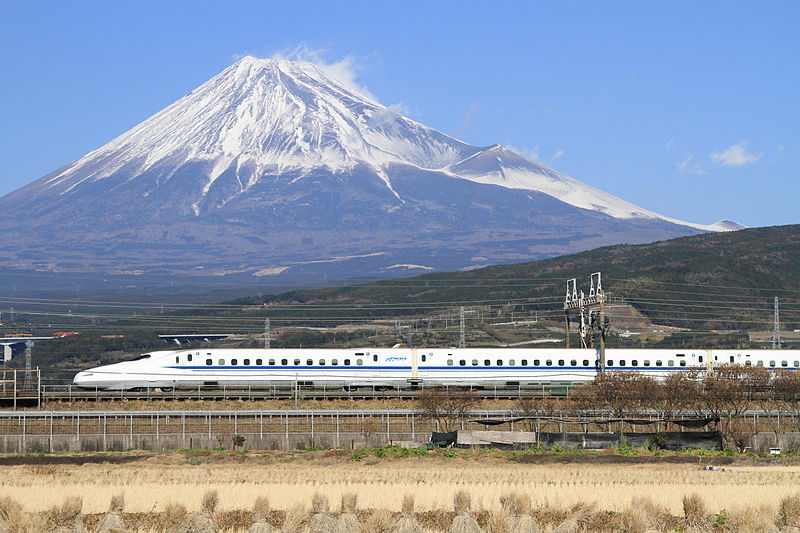
- TIP: If you are travelling south from the Tokyo region, try to get a seat reservation on the right side of the train. About 40-45 minutes outside of Tokyo, you will have a glorious view of Mount Fuji. These seats tend to sell out quickly so if you are efficient try to book them a few days ahead of your journey.
Etiquette, food, and drinking
Japan is a country that is built on order, conformity and politeness. While no Japanese person will yell at you for social faux pas, they will judge you with their stares. Here are a few things to consider:
- It is perfectly OK to eat and drink on the trains. In fact, every station has many food stalls serving prepared foods. One of the most popular is the eki-ben. Eki is the Japanese word for station while ben is the abbreviation of Bento Box. So an Eki-ben is a Bento Box you can buy in the station and enjoy on the train as you watch the countryside whiz by at speeds of more than 275 km/h.
- Japan is a clean society so remember to take your rubbish with you when you leave the train. There are rubbish bins on the platforms so you can get rid of your garbage there.
- It is considered rude to chat on your mobile in the seating areas. Go to either end between the carriages if you need to use the phone.
In the next section, I will write about accommodations which can be a challenge considering Tokyo is among the world’s most expensive cities. I will introduce you to capsule hotels, business hotels, and ryokan hotels.
 Taking the road best travelled